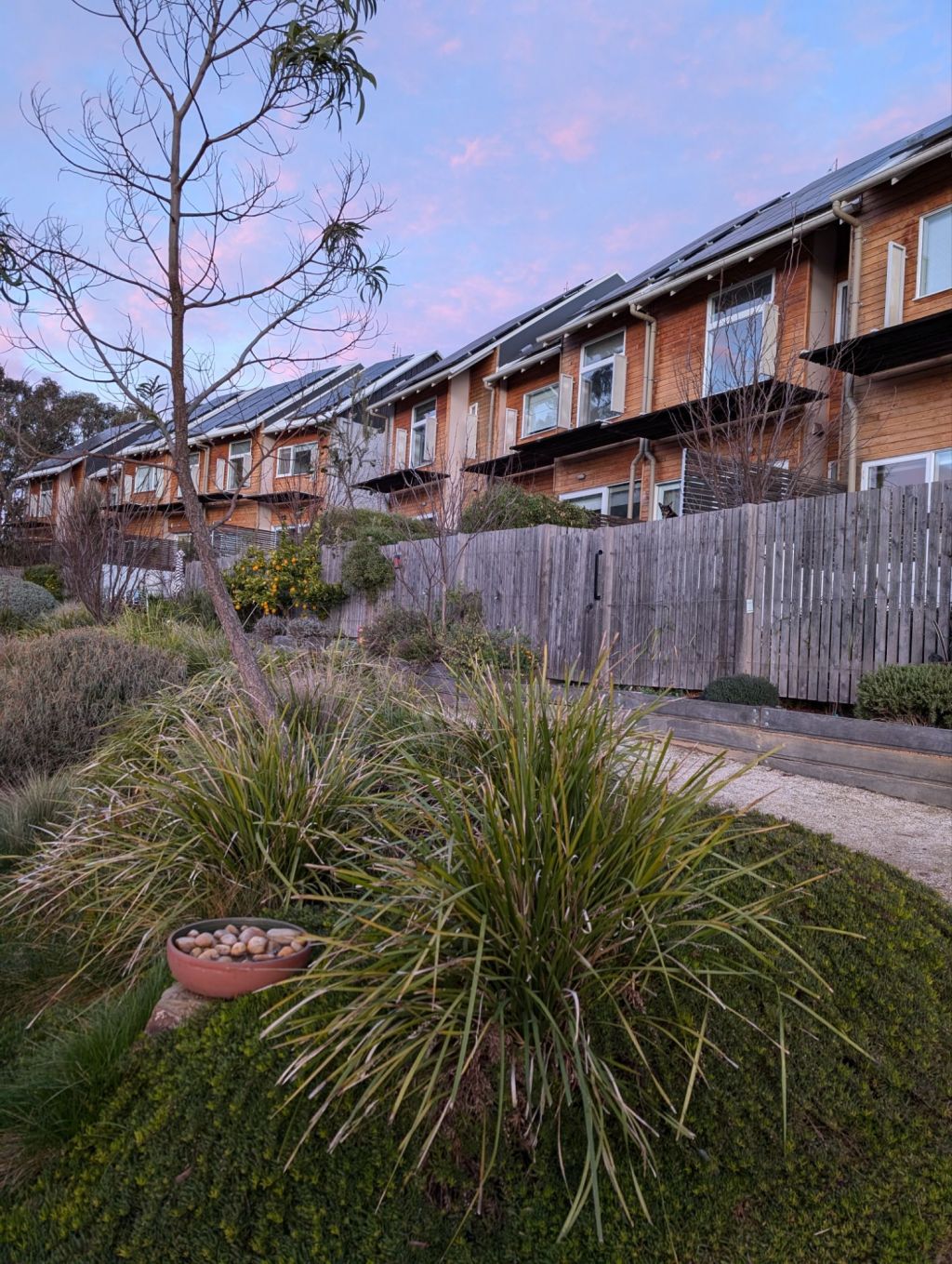
What does Regenerative placemaking look like when its low to medium density – in this case study I explore how to heal country to provide a healthy place for people and the environment.
In a recent article with the Future of Cities and Bill Reed, we introduced a set of five interrelated components for moving regenerative placemaking forward. In this post I will explore what these looks like in place, in this case in the town of Castlemaine, Victoria, Australia. The development is called The Paddock, designed by Crosby Architects.
Introducing Castlemaine
Castlemaine is a town of 10,000 people 129 km north-west of Melbourne, 280 meters above sea level, with between 400-800mm of rain per year.
The custodians of the country, the Dja Dja Wurrung and Taungurung Aboriginal people live in the area and have done so for many thousands of years, “they had a thriving economy based on the barter of greenstone (diorite) for axe heads, food, possum skins, wattle gums, spinifex resin, grinding stones and ochres” (Thematic Heritage Study 2016).
After colonialization a settlement that would eventually become Castlemaine was set up here because gold has been found. This led to its early western style development and economic prosperity, though it left the land heavily impacted.
After the gold rush the town shifted to agriculture and over the last 30 years has been evolving in a nuanced niched community still including farmers but also with a great deal of arts, music, great food and wine, authors, and academics.
Introducing the Paddock
Neil and Heather Barrett initiated the development after living next to the site for 40 years and conversations with the architect Geoff Crosby who had is practice based on the site at the time.
Geoff had been inspired by a talk in 2011 given by the then CEO Jason McLennan of the Living Future Institute to apply the principles of the Living Building Challenge. This built on Geoff and the Barrett’s evolving ideas around supporting local community sustainability giving it an aspirational framework to apply.
Much of the work presented is the outcome of a decade of work but below are a summary and some reflections of Much of the work presented here is the outcome of a decade of work. I have made an attempt to capture the essence of how the project maps across the regenerative-placemaking components. Yet as I write I still feel there are some many rich stories and nuances that just aren’t able to be captured in writing, they need to be experienced.
Transdisciplinary research and education, acting as a vehicle for knowledge exchange
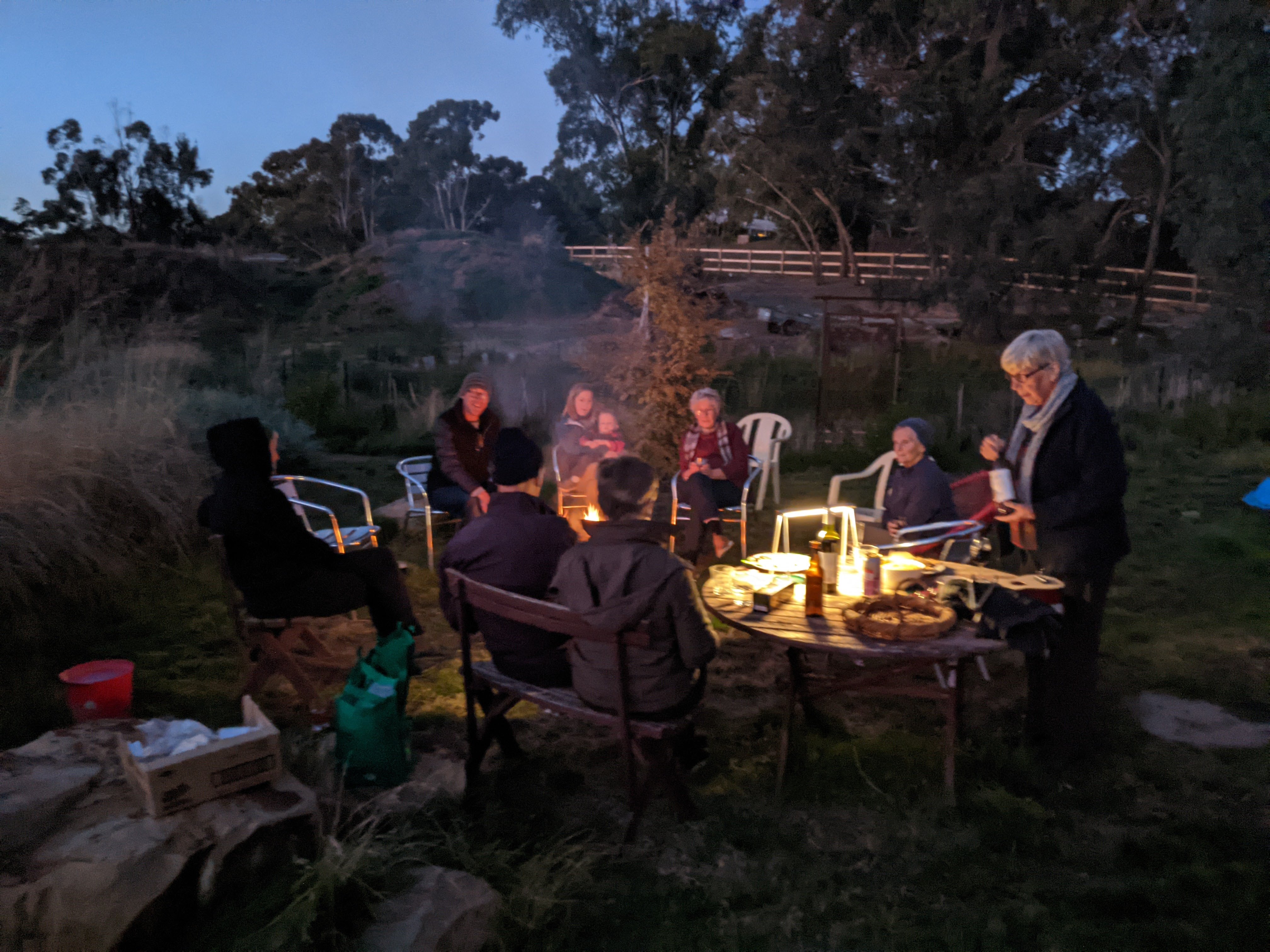
The Paddock projects started with a great deal of research on the part of Geoff Crosby and his team. I was involved in the periphery, helping where I could, managing to a small extent, the relationship with the Living Futures Institute. One aspect that I did organize and manage was a citizen science activity where locals and students came and worked with us to do an ecological survey of the site. This was funded by the Australian Communities Foundation.
We brought together the University of Melbourne with the local Latrobe University to carry out the documentation of the analysis and to engage students in both the assessment and recommendations. We provided food from the local community run food coop. The survey was carried out across three seasons and included quadrant studies, water, bird, plant assessments and general observation and motion camera data logging.
The outcomes of the ecological analysis were taken by ecologist Cristina Hernandez Santin to create a plan of what it could look like if we restored the ecosystems. This was then used by the landscape architects to design the site response. From this it was determined what success would look like. That was ecologically speaking success would be the return of 5 key stone species – the powerful owl, the sugar glider, the growling grass frog, the legless lizard and golden sun moth.
Regarding knowledge exchange, and as part of the living building intention, the outcomes of the project are readily shared, with periodic tours of the development, and so forth.
Living systems thinking, employed as a way of understanding the socio-ecological aspects of place
The above describes the ecological thinking, which was can we heal the country and bring back its vitality and viability to support the species of the area. The social components were around a conscious governance process, an upskilling of all residents and a development of agency within the community to own their onward journey of connection to the place.
All the phase 1 residents participated in a workshop that outlined the intent and design principles of the development. In preparation, the team worked with a researcher to look at community governance processes to develop one that could be owned and tailored by the community. From these workshops the following emerged:
“The layout and features of the community centre were discussed at the Stage 1 workshops, helping the project team to integrate new expectations and ideas. These included a meeting and leisure area and a laundry and kitchen for community events, all on the ground floor.
Further ideas that have been incorporated from the workshops are
– The 2nd storey now operates as a B&B, independently with toilets, kitchenette and private access and is listed by Air B&B.
– the building has been extended to accommodate more people and it includes a disabled toilet and more storage space.
– the communal laundry has been relocated and is now connected to external clothes lines.” (source)
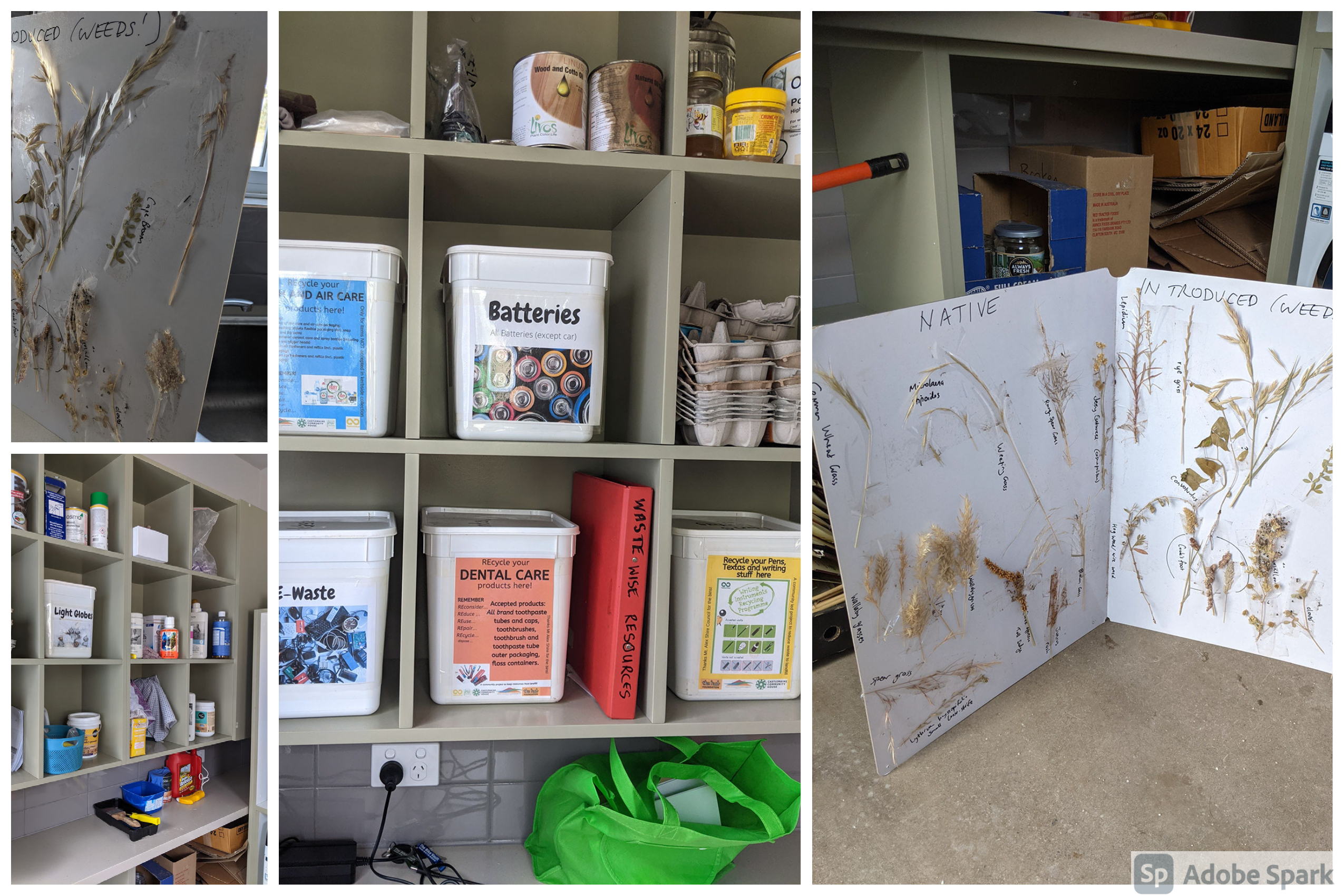
This type of engagement and adoption of participant ideas meant that the phase 1 residents felt a sense of agency over the thriving of the place. As such they took it upon themselves to organize things such as the shared resources area, the education of everyone on weeds and local beneficial plants, the management of the welcome and integration of the new residents, and much more. Below are images of the laundry area and the ‘what grasses are what’ resource they created.
Adaptation over time
Moving to phase 3 and 4 the project has had to adapt and change, especially as through covid there have been material shortages, changes in the availability of builders and trades and increases of costs because of all of these things.
An example of how the project had been responsive to the changes is electric bike and car charging. Though the development always envisaged some bike storage, demand for electric bike and car charging has increased significantly which has meant the need to build more spaces.
“…so far as we have had to be nimble and change along the way. The recent example of that is we have found there are more bikes being used than we had envisioned, and that is a great thing, however we’ve had to add an additional 2 bike sheds onto the plan – we only had one. Also rate of take up of electric vehicles in society in general is being reflected in the number of electric cars at the Paddock and so what we had for car charging in original plan has had to be revisited.” Comment via email from Heather Barrett Sept 2021
Rigorous and inclusive community engagement to gather the patterns/essence of place, identify the values and needs of the present and past, and deliver an ongoing strategy for engagement at self, group, system actualization levels
Like many aspects of working in a regenerative way, all things are related, so this component in inextricably linked to the others. Here I would like to reflect on the site design to create sightlines through the development and how this has been taken on by the community – see the image below between the building blocks.
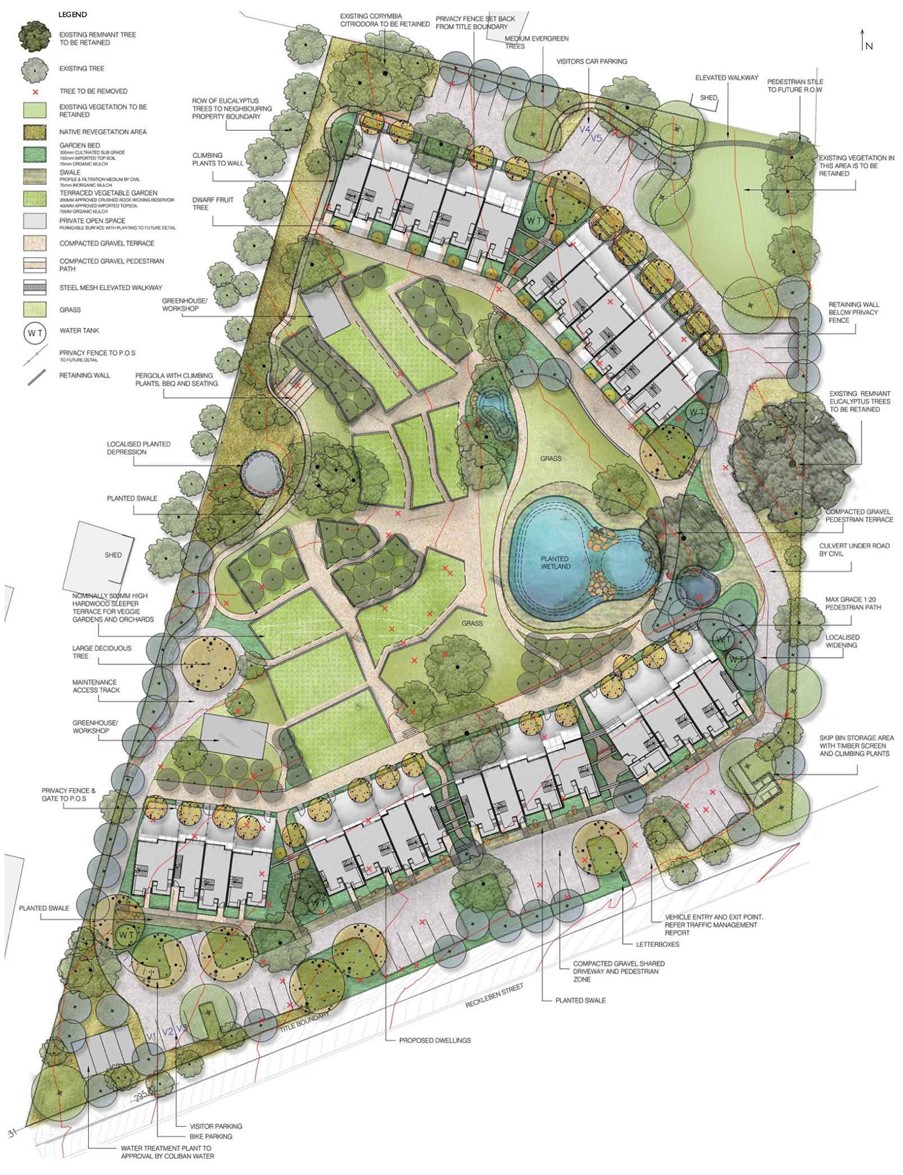
As the landscape architects video above mentioned they broke up the development to create sightlines. In a biophilia workshop, as part of the Living Building Challenge process, these sightlines became places where different periods of history could be celebrated. Through art, sculpture, planting, and curation by the community these will/could be the Indigenous history, the gold rush, the farming, the current quirky academic/arty/foody and the future sightlines.
When I discussed this with the community last time I was there, you could feel the excitement as they started imaging what they could do. At the writing of this post, there are still several stages to be built, so this is something that will hopefully land the future.
Ecological aesthetic (i.e., biophilia) and sustainability practices, assisting people to visualise a healthier living environment
It was always the intent of Heather and Neil to leave this piece of land better than when they bought it. Before embarking on this development, they were already planting trees and clearing out weeds. Working with the architects, their own passion for the environment, the ecological evaluation outcomes, the landscape architects developed how to work with the ecology of the site.
Connecting to the ironbark forest system of the region, the project is maintaining most of the native trees already on the site and incorporating a native landscape strategy where the intention is to enhance the biodiversity system by 50%. Native vegetation surrounds the homes and permeable paths conserve water. The landscape proposal emulates permaculture principles and understands the project site as part of a broader landscape.(source)
In regenerative terms they aimed to increase the vitality and viability of the ecosystems through working on water, soil, removal of mal-adapted plants and weeds and management of toxins. In placemaking terms this was further developed, and will be carried forward through the agency of the residents. See for example the images above of the weed and native grasses board.
This will be further helped through the employment of a Paddock handyperson. RyanM, sustainability reporter interviews Neil below on how this will work.
Regenerative placemaking interventions (i.e., pop-up parks, festivals), as a way of trialing programming and design ideas for long-term projects and planning initiatives.
To build up the momentum of this development, the architects together with Heather and Neil held workshops with community, had open days, spoke to the community and at various events and held workshops to support the development’s directions.
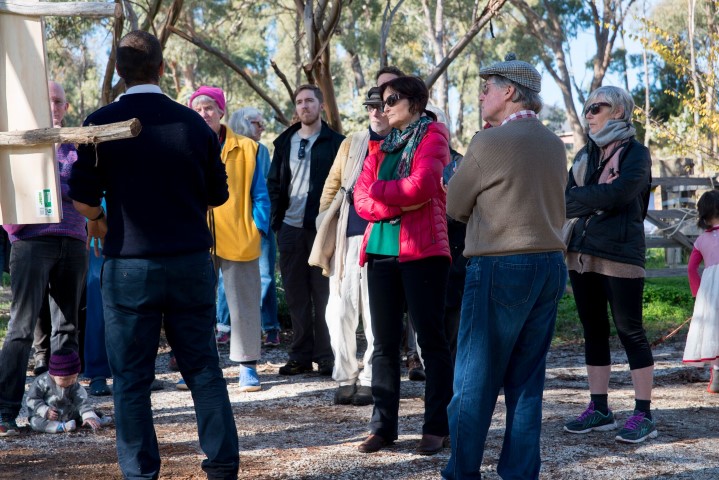
To this day, there are still regular site tours and those who buy into the development have input into the design of their own homes. Further, as the development is built in stages, the project has learnt as it goes, seeing what works, what could be done better and able to pivot when unexpected things occurred.
The journey will continue over the next 5 to 10 years as the new residents settle in, everyone builds relationships with each other and the land and they co-create what it means to thrive together.
In their own words:
Our vision is to create a new standard for sustainable living that fosters a sense of community and closer connection to nature.
The Paddock eco village is, and will be, a beautiful place to live for people who enjoy a green lifestyle.
Residents enjoy high levels of comfort in customised, architect-designed homes in a peaceful bushland setting only 1.4 kilometres from the centre of Castlemaine. Houses, made from timber and some recycled brick, range in size from 2 to 4 bedrooms, occupying sites between 84 to 120 square metres including a private front and back garden. Homes are highly energy efficient, with an average 8.1 star rating, which not only keeps running costs low but means that each property produces more energy than it uses.
Around two-thirds of the total land will be dedicated to shared food gardens, orchards, planted wetlands, small wetlands and native gardens. Car parking is limited to the perimeter, close to the back of each house, creating a central garden area that is both safe and serene.
A walking track already connects the property with nearby bush and provides quick access into the centre of town, the train station (with regular services to Melbourne and Bendigo) and nearby schools.
The Paddock eco village offers an outstanding sustainable lifestyle close to the heart of one of Victoria’s most dynamic regional centres.
I love this development, its community, and what it is doing to show what is possible.
Dominique


 Newport Lakes Stories and Contributive Practice
Leave a comment