
This is the transcript of a conversation has for the development of the book Trends in Urban Design.
Introduction
Dominique Hes is a key thinker in sustainability, regenerative development and placemaking in the Melbourne and Australian research community and society well as a respected scholar internationally. For many years she worked at the University of Melbourne in the Faculty of Architecture, Building and Planning, teaching young designers to think laterally, and making them familiar teaching emerging designers to think laterally, and connecting them to the potential of regenerative human potential.
She has inspired many to integrate and apply the principles of regeneration, resilience and sustainability through her teaching, research, projects, and publications. It all came together in the award winning, cornerstone book she wrote together with Chrisna du Plessis, Designing for Hope. After leaving academia to create on the ground action she worked at Beyond Zero Emissions, showing what thought leadership means on how we can live in a world that stores more carbon than it emits. Where carbon is a source of potential and thriving, not a problem to dispose of. Additionally, she works on restoring ecological systems through Chairing the Board of Greenfleet, a not for profit that restores ecosystems, where possible with Indigenous custodians, through carbon sequestration investments.
A month ago, she accepted her greatest challenge, to support the whole of the built environment of the City of Melbourne to reach zero carbon by 2040. Practically, Dominique has supported the development of projects such as The Paddock, in Castlemaine, one of the first truly regenerative neighborhoods in Australia, shaped with and by the community to restore nature while creating healthy places for people to live.
Learn to love the ocean We are nearing a shift in mindset. We used to say that if we want to help people in a vulnerable situation it is better to teach them how to fish than bring them the fish. This still emphasizes the value in how many fish they want, need, or can catch. Instead, what about if we teach them to love the ocean. Be cause if you love something you will take care of it and the question pivots from what ‘I get, can I extract’ towards what can ‘we contribute’.
What does this mean when the values shift from extraction to contribution? Have we seen this before in human development? The answer is yes, if we look at the transition or innovation curve, we see how over time we have continually seen the limitations of the previous way to interacting with the world and develop new ways, with new values.
Dominique argues that we are currently seeing the limitations of our extractive values, yet we have not quite resolved what the new ones are. It is a time of chaos, of innovation, of potential. A time where the innovators, will experiment with many new ways, there will be a lot of new theories, approached, terms, and concepts developed until one takes hold. If you look at the innovation curve the innovators are the first 2-5 percent, the early adopters around 12-15 percent. It means that for the new worldview and its values need around 14-20% of the population to become the new approach.
With an increasing number of people, especially the young, seeing the limitations of our extractive system, and an increasing number of people developing what contributive system looks like, Dominique argues we are around the 15% mark. What we call this new worldview will be something we will only know once we look back. What will help us move through this disruptive phase more rapidly will be the ability to create visions of what the new worldview will look like. We need to imagine a future, have a vision, that paints what this will look like, see ourselves in it.
This contributive set of values, this new world of interdependence, connection, relationality will be a difficult one for Western societies. The work of Joseph Henrich (Henrich, 2020) has shown that Western people have rewired their brains because of the literate, analytical, mechanistic ways of learning. Our reliance on how we learn, through books, means we have a transactional approach to knowledge. We read, we might highlight a few things, we write a few things down, and if we are lucky, we remember a few of them. We look through publications, papers, books to find the quotes and ideas that support our own thinking, seldom going on the journey with the author of the whole book.
This approach to learning began with writing, disconnecting knowledge from place. It was popularized through Christianity and began to transform the structure of the Western brain when it became mainstream as part of our educational process. Slowly, disconnecting us from the ability to see patterns, place based observation, relationality, connection of ideas to the physical reality of context.
Disconnecting knowledge from context leads to completely different decisions, abstract concepts that do not relate to the reality of our physical world. Dominique argues that this leads to many of the problems we have today.
“The way we think impacts the way trust is built.
Where Western societies disassociate from place,
Indigenous communities strongly related to place,
to country because of their oral ways of knowing.”
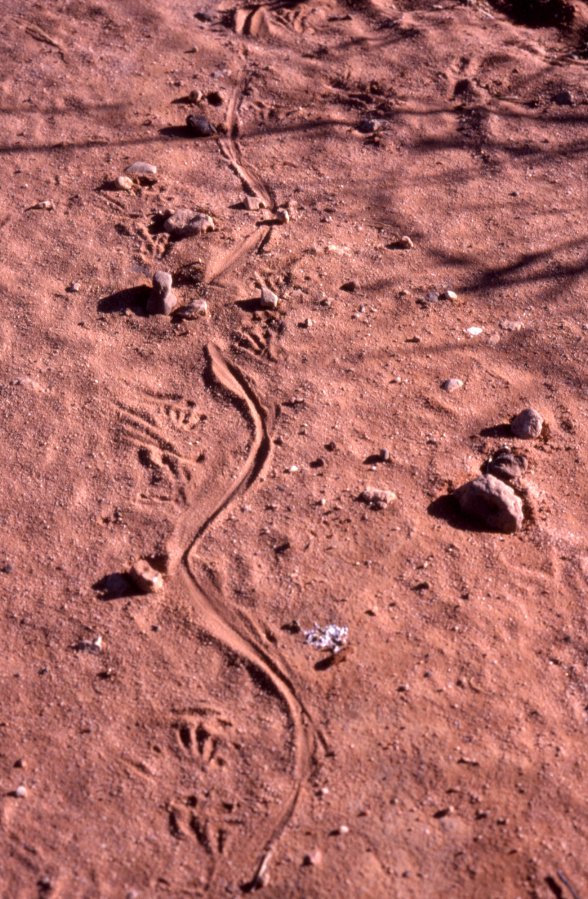
Oral ways of knowing are completely different, they are place dependent vast amount of information are stored in story, art, song, and the haptic (physical) aspects of place. To learn, one must be completely present listening and finding the knowledge in the story. Critically, this knowledge needs to be remembered, and passed on correctly for the community to survive. Oral ways of knowing therefor build the relational, contextual, observational parts of the brain.
As we search for the new worldview, we need to bring these two parts of the brain together, developing both sides. One is not better than the other, both are needed, like wings on a bird, one wing being stronger than the other does not enable the bird to fly.
Our brain has both capacities: the literate side is good at breaking things apart, is analytical, reductionist and conceptual, while the oral side of the brain is better at relationality, the understanding of whole systems and connecting.
Oral teaching and learning
What does this all mean for how we teach? Do we teach to the way we know has limitations, or do we teach to enable our students to connect to the emerging worldview? How do we enable both a capacity to use data and excel sheets AND relate these to reality, construct and develop narratives and stories? What is the role in design in this context? Dominique argues it is critical. Design when truly connected to place, to developing the potential of placed, and enabling all stakeholders to see themselves in that place is immensely powerful in this emerging worldview.
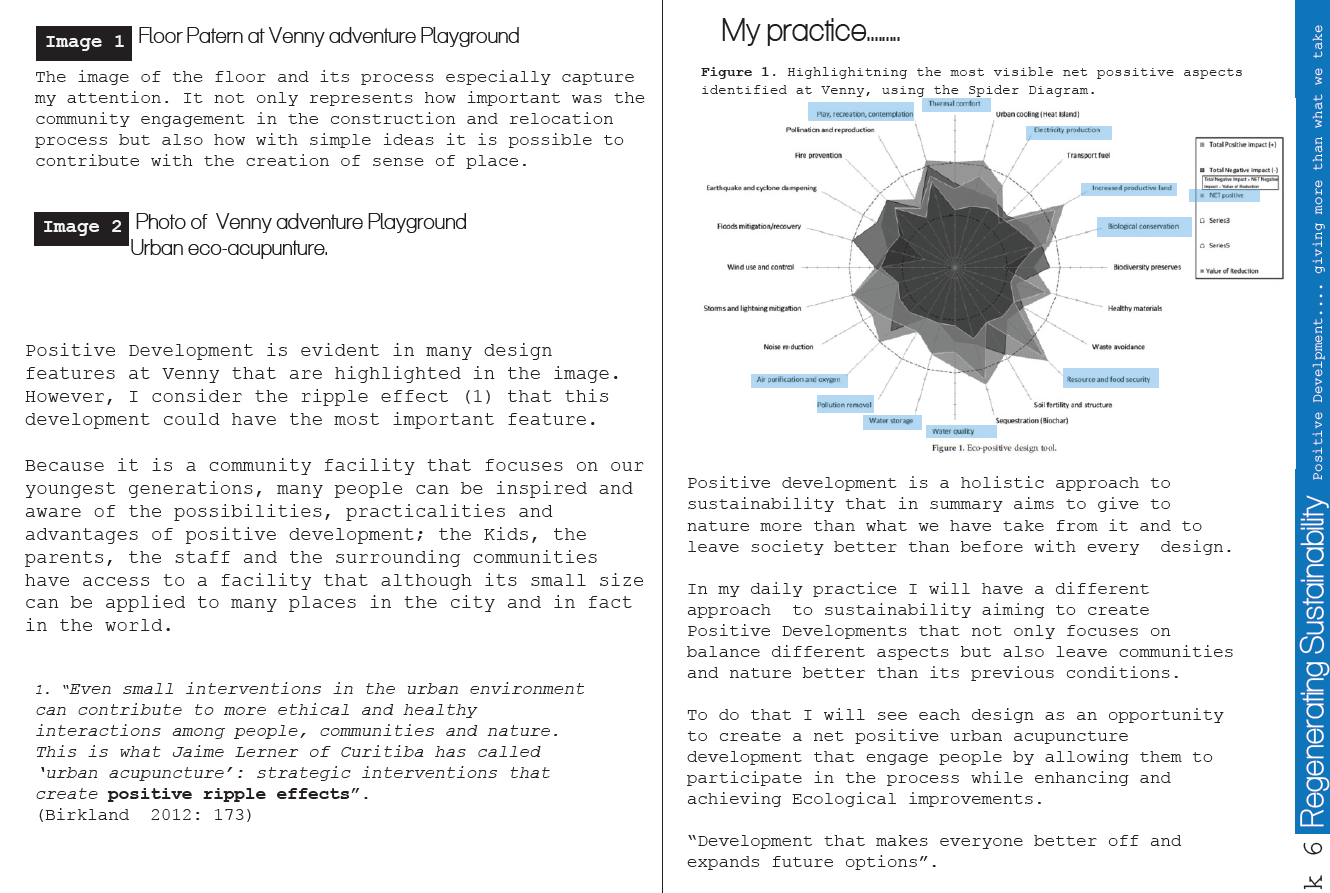
An example of this from her practice at the University of Melbourne where she taught students to train both sides of their brain. Teaching Regenerating Sustainability she asked her students to relate what they learnt each week in a reflection card. The card required them to use their brains in seven different ways:
Analytical:
- Show understanding of the content – references, concepts, critique
- Quote someone else that supports your understanding
Grounded in place, in reality:
- Apply understanding to a project
- Apply what this understanding is to their own field of expertise, their practice (architect, planner, landscape architect, scientist, ecologist, etc.)
Oral:
- Connect understanding to an image
- Pick a song that explains the content
Together
- Explain why the image was used
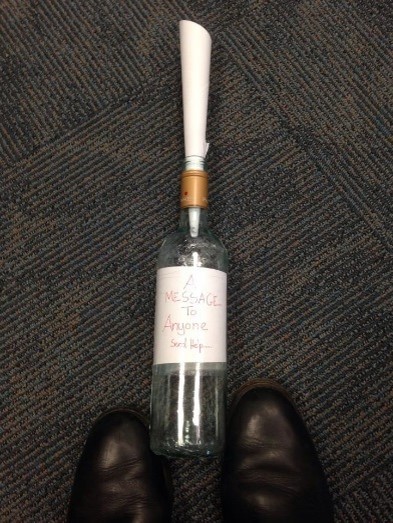
The students were encouraged to be creative; the basic assessment was a card, but they could create anything as long as it contained those elements. Some made cards, but others made cubes, or dioramas, or dream catchers, or websites, or a puzzle. Each week the teaching staff gave students feedback, coached them and were ready to be engaged. This led to a strong connection of the students with their designs, and a new holistic.


Zero-carbon in 2040
When asked what this means in practice, when working on real life policies, strategies and initiatives Dominique said: “When aiming to become zero carbon I, 2040 at my new role at the City of Melbourne” … “my sense is that we should not limit ourselves to calculating the embodied and operational energy in Melbourne’s built environment. It is all about creating the scaffold that allows people to develop emergent strategies to contribute, each in their own way to zero – or beyond zero – carbon.
Acting in service of life rather than measuring progress. The most effective way of reaching our ambitions is to invest at least 25% of the budget in memorable ideas, collaboration, engagement, celebration, and joyful experiences – creating that loving of place (loving the ocean). I believe in enabling the process rather than controlling it, developing capacity rather than finding the one truth.”
Time
Change and transformation that is constructive and generative needs to be a supported by slow processes. This means that making a difference is happens in little steps. Taking a first little step, gathering, and understanding the feedback, adapting to it, adjusting, reflecting, and testing before taking the next little step.
Design is an activity and a profession which, by nature, helps to become agile and adaptive. Humans are very capable at following this transition process, by using their unique capacity of creativity and intuition. We are imaginative. We can incorporate the teaching of these skill more effectively in our education and not take it for granted (and meanwhile focusing on taking in other kinds of knowledge).
We must get the intent of creativity right. Therefore, major questions in design teaching are holistic and
connective:
– How do we bring ideas together emergent from place and context?
– How can we communicate them to that they resonate and build capacity?
– And how do we learn to see the connections.
We have the opportunity in our design education to build the capacity to paint a vision as effective storytellers. How do we measure (Hes et al., 2020) success of this new worldview, which aims at creating balance, is oriented to the long term, and explores mutual dependency? Perhaps we could measure place, or how well placemaking satisfies the needs of communities, nature, and the land.
We need to develop the enabling capacity of our students, teach them to seeing the seasons, empowering local communities, enrolling the community in understanding the place, to adapt to future change and building the enrichment of the place. Enabling versus just making. Again, start small, and do it in a little-by-little step-process. The smaller the problem, project, site, the more effective as it enables deep engagement and listening to stakeholders and outcomes.
What do our students need to learn?
- Training the oral capacities of the brain not only using drawing, music, stories, dance, poetry but connecting to place, relating these to context and the real world
- Understanding the small, the quick and the short in the long-term perspective, developing
capacity and ways of seeing future potential - Developing advanced skills in creativity, listening to intuition, and imagination
- Connective designs, that bring ideas together and convincingly communicate potential, evocative, engaging, and relatable futures
- Basing everything on real context, developing relationality, working with the community in a way that is capacity building for the community as well as the students.
- When designing for place, designing to build not just social capital and capacity but also natural ecological health and wellbeing.


 Newport Lakes Stories and Contributive Practice
Leave a comment